
Authorization Readiness Levels
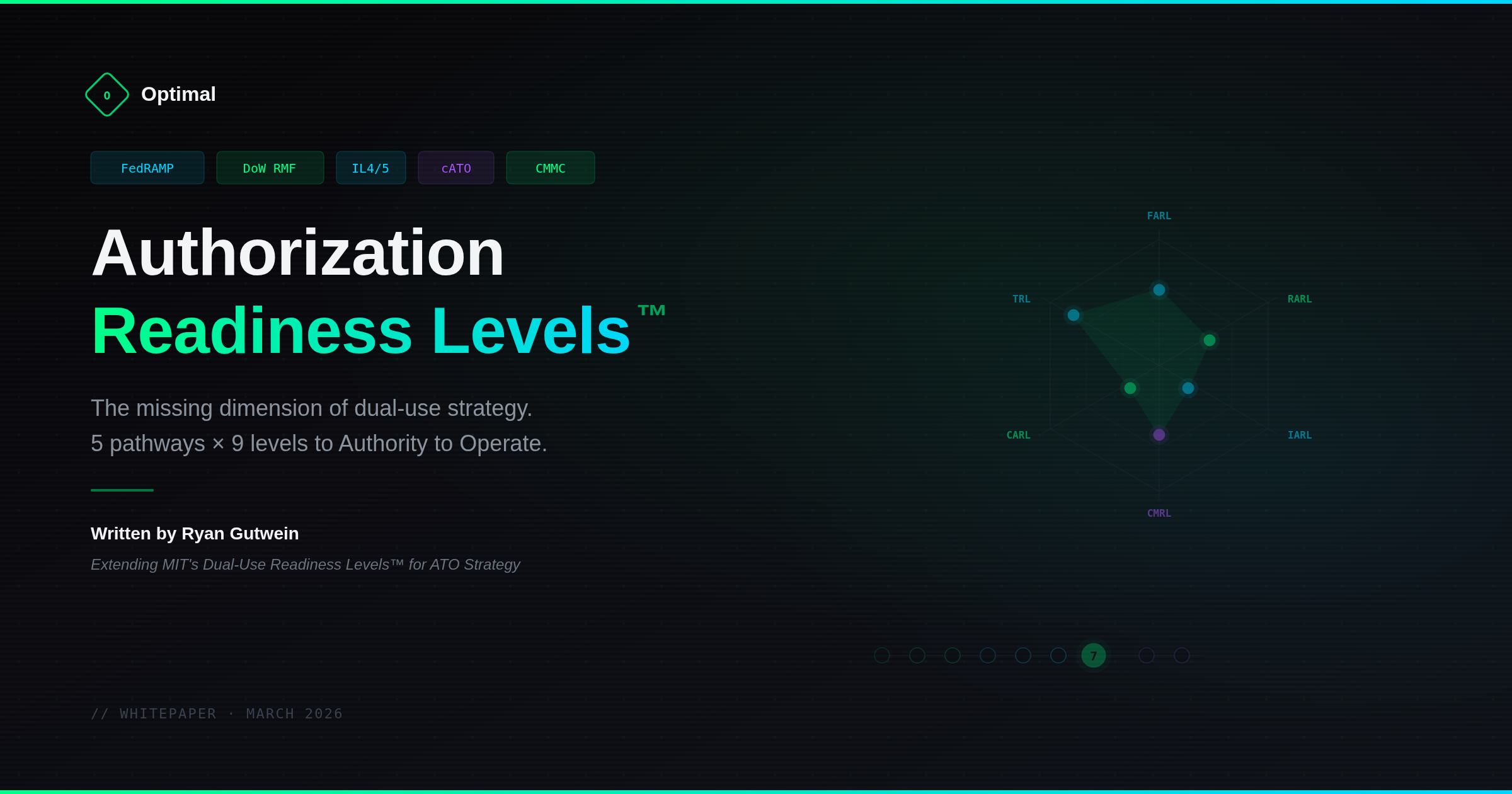
A framework mapping 5 ATO pathways × 9 readiness levels for dual-use companies navigating FedRAMP, DoD RMF, Impact Level, cATO, and CMMC authorization.
Framework Overview
Five Pathways, Nine Levels
MIT’s Dual-Use Readiness Levels framework gave the defense tech ecosystem a shared language for measuring startup maturity across five dimensions: technology, commercial funding, commercial customers, mission funding, and mission customers. But for any software company selling into the Department of War or broader public sector, there is a sixth dimension that often determines whether a promising product ever reaches the warfighter: authorization to operate.
Authorization Readiness Levels (ARL) is a complementary framework that maps the pathway from “we know we need an ATO” to “we hold production authorizations across multiple agencies and pathways.” It covers five distinct authorization pathways, each with its own 9-level progression from initial awareness through scaled, multi-agency operations.
| Audience | How to use ARL |
|---|---|
| Founders | Assess where you are, plan where to go, and communicate your ATO strategy to investors and government stakeholders |
| Investors | Evaluate authorization maturity and understand the timeline and investment required to unlock government revenue |
| Gov stakeholders | Understand where your vendor partners are in their authorization journey and what they need to advance |
| Pathway | Code | Focus | Owner |
|---|---|---|---|
| FedRAMP Authorization | FARL | Federal civilian cloud authorization baseline under Rev 5 and the emerging 20x pathway | GSA / FedRAMP PMO |
| DoW RMF Authorization | RARL | Risk Management Framework pathway through eMASS, governed by NIST 800-53 and DISA STIGs | DoW Authorizing Officials |
| Impact Level Authorization | IARL | DoW Cloud Computing SRG pathway to IL4, IL5, and IL6 Provisional Authorizations | DISA |
| Continuous ATO | CARL | DevSecOps-native pathway to continuous authorization, aligned with DoW Reference Design and SWFT | DoW Program AO |
| CMMC Certification | CMRL | Cybersecurity Maturity Model Certification for protecting CUI across the defense industrial base | CMMC PMO / C3PAOs |
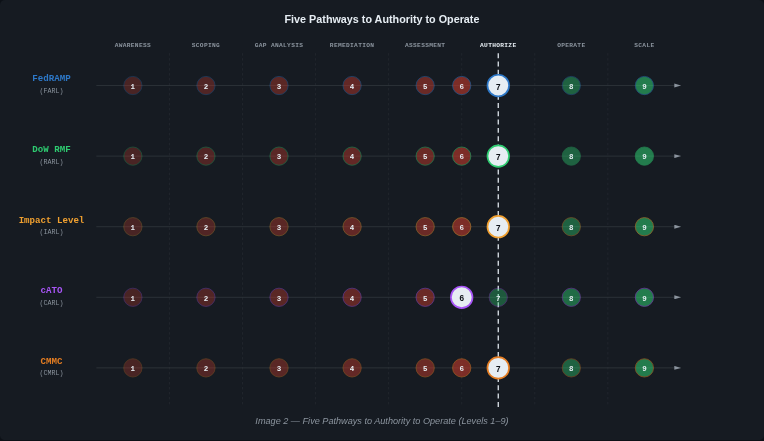
Each pathway runs the same 9-level progression (levels 1–9).
Readiness Dimensions
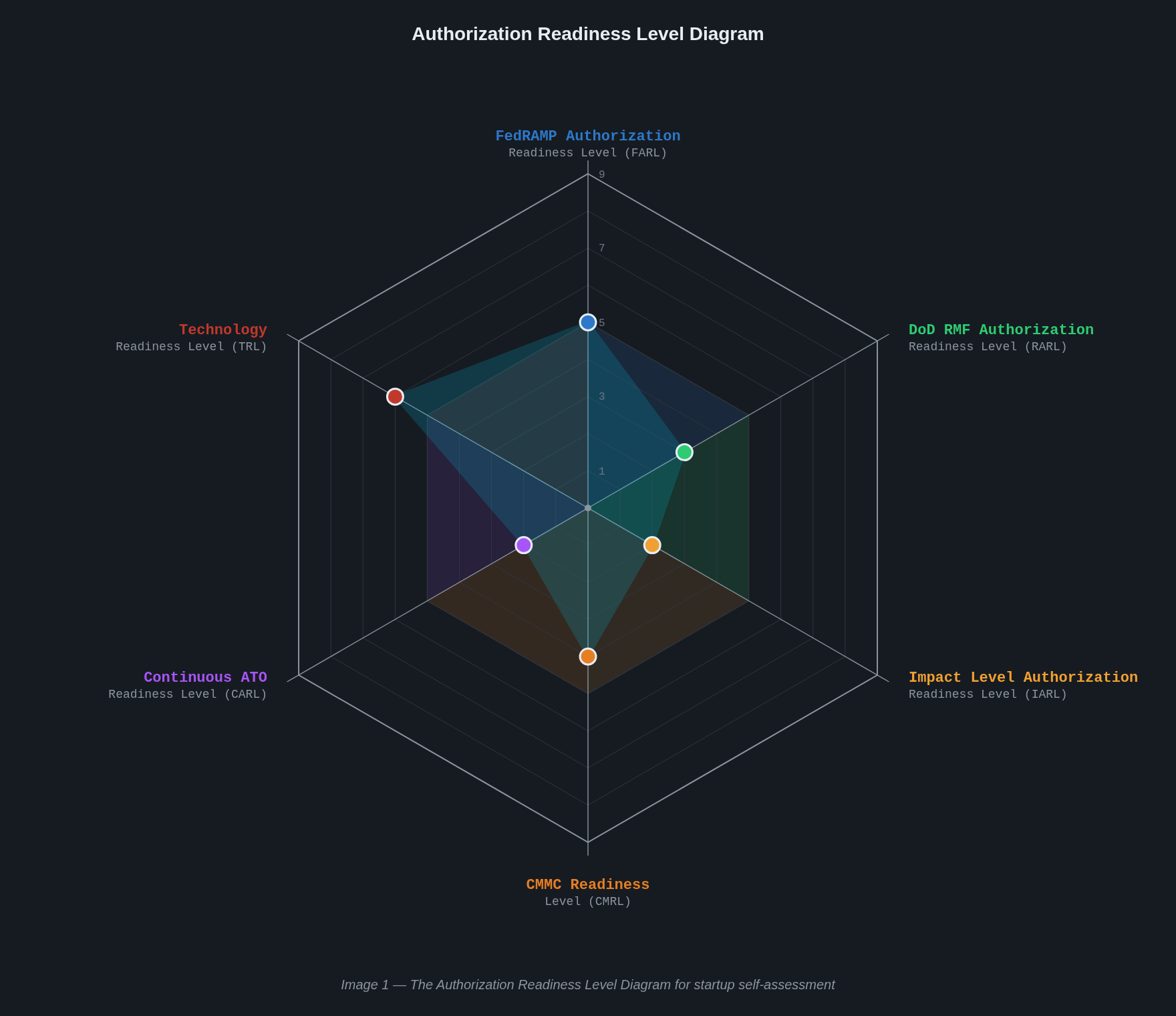
How Authorization Intersects with Every Readiness Dimension
| Dimension | How authorization intersects |
|---|---|
| Technology (TRL) | Architecture decisions at TRL 3-5 determine whether your system is authorizable at all |
| Mission Funding (MFRL) | SBIR and OTA awards increasingly expect authorization pathway plans as deliverables |
| Mission Customer (MCRL) | The Authorizing Official who signs your ATO is a mission customer stakeholder |
| Commercial Customer (CCRL) | FedRAMP authorization is increasingly valued as a trust signal in healthcare, finance, and critical infrastructure |
| Commercial Funding (CFRL) | Investors evaluate ATO readiness as a proxy for government revenue predictability |
Universal Pattern
The 9-Level Journey
Every authorization pathway follows a universal arc from awareness through scaled operations. The specifics differ, but the shape is the same.
| Level | Stage | Phase |
|---|---|---|
| 1 | Aware | Discovery & Planning |
| 2 | Scope | Discovery & Planning |
| 3 | Gap | Discovery & Planning |
| 4 | Remediate | Build & Assessment |
| 5 | Submit | Build & Assessment |
| 6 | Assess | Build & Assessment |
| 7 | Authorize | Authorized & Scaling |
| 8 | Operate | Authorized & Scaling |
| 9 | Scale | Authorized & Scaling |
Pathway Details
Pathway Deep Dives
FedRAMP Authorization Readiness Level (FARL)
The federal civilian baseline. FedRAMP operates under a unified authorization model since the JAB was dissolved in August 2024, with Rev 5 alignment and the emerging FedRAMP 20x continuous validation pathway replacing the traditional assessment cycle.
- Awareness
- Boundary Scoping
- Gap Analysis — 3PAO/RAR
- Remediation & SSP
- Sponsor Secured
- Assessment Complete
- ATO Granted
- Marketplace & Reuse
- Sustained & Evolution
Read full pathway details in the whitepaper →
DoW RMF Authorization Readiness Level (RARL)
The DoW-specific Risk Management Framework pathway, operationalized through eMASS and governed by NIST 800-53 and DISA STIGs. This is the pathway for systems deployed directly on DoW networks and enclaves.
- Mission Need & RMF Awareness
- System Categorization & eMASS
- STIG Assessment & Planning
- Documentation in eMASS
- SCA Engagement
- Assessment Complete
- ATO Granted
- Operational ConMon
- Multi-Enclave Maturity
Read full pathway details in the whitepaper →
Impact Level Authorization Readiness Level (IARL)
The DoW Cloud Computing Security Requirements Guide (CC SRG) pathway to IL4, IL5, and IL6 Provisional Authorizations, managed by DISA. Required for cloud services handling CUI and national security data.
- IL Strategy Determination
- Isolation Architecture Design
- CC SRG Gap Assessment
- DISA Engagement & Application
- DISA Assessment In Progress
- Findings Remediated
- PA Granted
- Production at IL with ConMon
- Multi-IL Strategic Positioning
Read full pathway details in the whitepaper →
Each level includes detailed descriptions, examples, and actionable guidance. Download the 29-page whitepaper covering all 5 pathways →
Continuous ATO Readiness Level (CARL)
The DevSecOps-native pathway to continuous authorization, aligned with the DoW Enterprise DevSecOps Reference Design and the Software Fast Track (SWFT) initiative. cATO replaces 3-year assessment cycles with ongoing, automated validation.
- DevSecOps Foundation
- Security Tooling in CI/CD
- Continuous Monitoring Architecture
- Hardened Containers & Provenance
- Program Sponsor for cATO
- Initial cATO Issued
- Operational cATO
- Multi-Program Expansion
- Enterprise Reference Implementation
Read full pathway details in the whitepaper →
CMMC Readiness Level (CMRL)
The Cybersecurity Maturity Model Certification pathway for protecting CUI across the defense industrial base, governed by 32 CFR Part 170 and DFARS 252.204-7021. Affects an estimated 80,000+ contractors in the DIB.
- Awareness & Level Determination
- CUI Scoping & Asset ID
- NIST 800-171 Gap & SPRS
- SSP Development & Implementation
- POA&M Closeout & Readiness
- C3PAO Assessment Complete
- Certification Achieved
- Operational Compliance & Affirmation
- Multi-Level & DIB Leadership
Read full pathway details in the whitepaper →
By The Numbers
The Authorization Landscape
| Metric | What it represents |
|---|---|
| 80K | Contractors that need CMMC Level 2 certification |
| <600 | Certified CMMC assessors available |
| $500K–$2M | Typical FedRAMP Rev 5 authorization cost |
| 33x | ROI on a $1.5M FedRAMP investment unlocking $50M TAM |
MIT Mapping
Mapping to MIT’s Dual-Use Readiness Levels
Authorization Readiness Levels interact with every dimension of MIT’s framework. The following mapping shows typical alignment.
| Authorization Stage | Typical MIT Alignment | Key Implication |
|---|---|---|
| ARL 1-2 (Awareness, Scoping) | TRL 4-5, MFRL 1-2, MCRL 1-2 | Architecture decisions must be made with authorizability in mind. Most cost-effective time to design for compliance. |
| ARL 3-4 (Gap Analysis, Remediation) | TRL 6-7, MFRL 3-4, MCRL 3-4 | Compliance remediation should be funded — SBIR Phase II, OTA, or seed/Series A should include ATO budget. Expect $500K-$2M for Rev 5; potentially much less under 20x. |
| ARL 5-6 (Assessment) | TRL 7-8, MFRL 5-6, MCRL 5-6 | The AO is a mission customer. Managing the assessment relationship is as important as the technology itself. |
| ARL 7 (ATO Granted) | TRL 8-9, MFRL 7, MCRL 7-8 | Authorization unlocks production revenue. The inflection point for mission customer conversion. |
| ARL 8-9 (ConMon, Multi-Agency) | TRL 9, MFRL 8-9, MCRL 8-9, CFRL 6+ | Sustained authorization is a competitive moat. Investors value it. Reuse and reciprocity accelerate growth. |
Strategic Guidance
Key Principles for Dual-Use ATO Strategy
1 · Design for Authorization from Day One
The most expensive ATO decision is the one you don’t make early enough. Selecting a FedRAMP-authorized IaaS provider, implementing FIPS-validated encryption, and designing your system boundary at TRL 3-5 saves 6-12 months and hundreds of thousands of dollars compared to retrofitting at TRL 7-8.
2 · The AO Is a Customer, Not a Gatekeeper
The Authorizing Official and their team (ISSM, ISSO, SCA) are mission customer stakeholders. Build relationships early, understand their risk appetite, and treat the process as a partnership.
3 · Fund Authorization Like a Product Feature
ATO is not overhead — it is a product feature that unlocks an entire market. Budget for it in SBIR proposals, include it in OTA milestones, and present it to investors as go-to-market infrastructure. A $1.5M FedRAMP investment that unlocks $50M in addressable government revenue is a 33x leverage play.
4 · Leverage Inheritance and Reciprocity
Build on FedRAMP-authorized IaaS/PaaS to inherit 50-70% of the control baseline. Leverage reciprocity between DoW organizations. Use your FedRAMP authorization as the foundation for DoW RMF and IL authorization.
5 · Build Toward Continuous, Not Just Compliant
FedRAMP 20x replaces narrative SSPs with machine-readable KSIs and persistent validation. DoW cATO replaces 3-year cycles with continuous monitoring. FedRAMP aims to stop accepting new Rev 5 packages by late FY27 — the transition window is now.
6 · Treat Authorization as a Competitive Moat
Every additional agency ATO, every IL level, every year of ConMon history widens the moat. Protect and maintain your authorizations — they are among your most valuable business assets.
7 · Understand the Institutional Map
FedRAMP is managed by the FedRAMP PMO at GSA. IL PAs are managed by DISA under the CC SRG. DoW RMF ATOs are issued by individual AOs through eMASS. CMMC certifications are managed by the CMMC PMO with C3PAOs and DIBCAC. Understanding which institution owns which authorization prevents wasted effort.
Institutional Landscape
Who Owns Each Authorization
| Authorization | Owner | Framework / Authority |
|---|---|---|
| FedRAMP | GSA | FedRAMP PMO + Board |
| DoW RMF | DoW AOs | eMASS + DoDI 8510.01 |
| IL PA | DISA | CC SRG |
| cATO | DoW Program AO | DevSecOps Ref Design |
| CMMC | CMMC PMO | C3PAOs + DIBCAC |
Whitepaper
Download the Complete Framework
29-page whitepaper with all 5 pathways x 9 levels, detailed examples, MIT alignment mapping, and procurement guidance.