
FedRAMP 20x: A Step Forward on Paper, A Marathon in Practice
FedRAMP 20x promises to streamline cloud authorizations with automation over documentation. But across DoW, civilian agencies, and the IC, the real challenge is not the framework. It is the institutional inertia that governs how authorizations actually work.
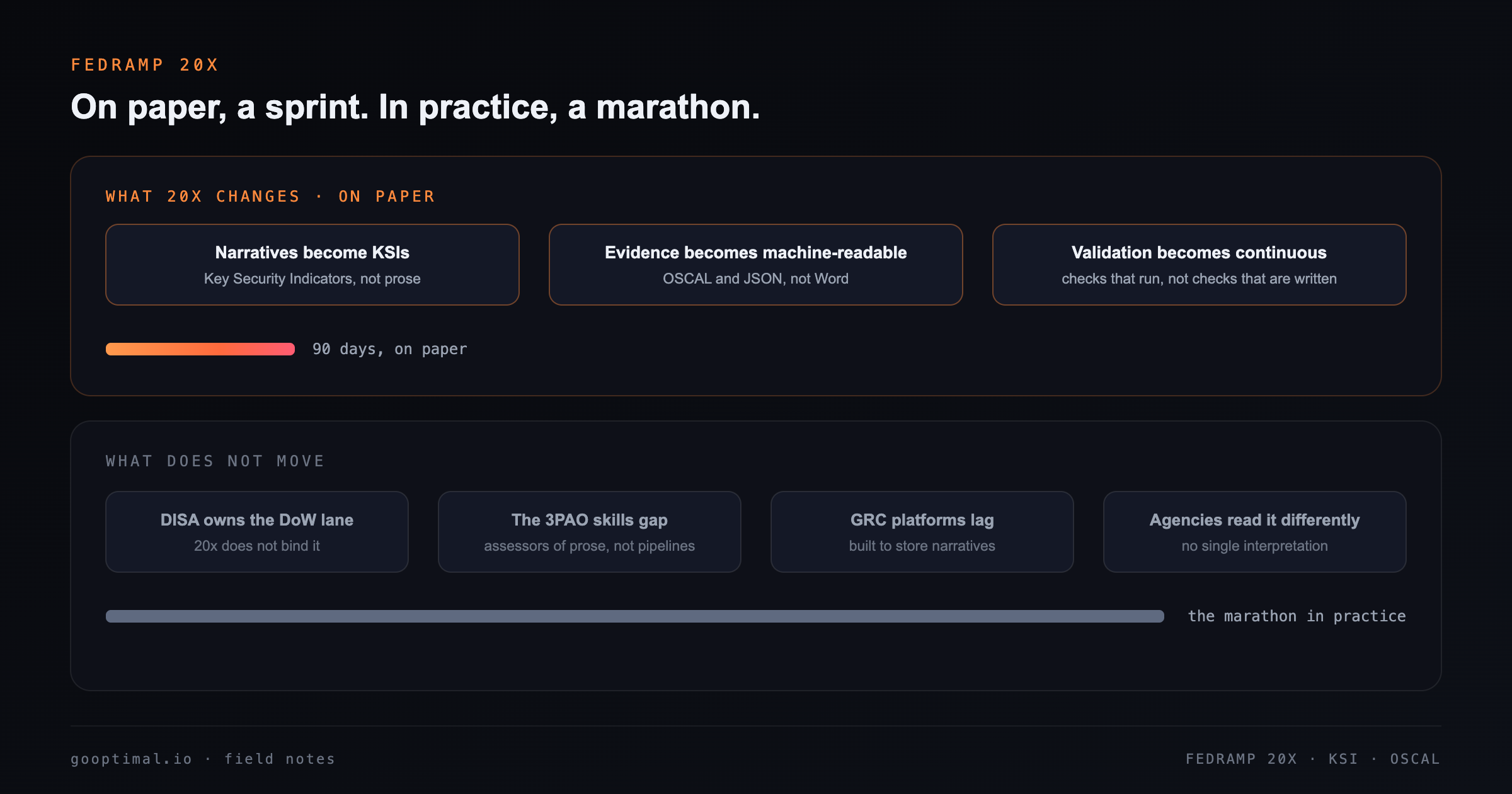
FedRAMP 20x has generated more excitement in the federal compliance world than anything since the original program launched over a decade ago. The premise is compelling: replace the mountain of static documentation and point-in-time assessments with continuous, automated security validation. Fewer narratives, more telemetry. Less paperwork, more proof. On its face, it is exactly the kind of modernization that cloud service providers, agencies, and assessors have been begging for.
And yet, if you spend time talking to the people who actually run authorization programs — the ISSMs at combatant commands, the DISA authorization teams, the agency CISOs managing dozens of system ATOs — you hear a more nuanced story. The enthusiasm is real, but so is the skepticism. Because FedRAMP 20x does not eliminate the compliance burden. It restructures it. And in some corners of the public sector, that restructuring runs headfirst into institutional realities that no framework update can solve overnight.
What 20x Actually Changes
To understand the gap between the vision and reality, it helps to be precise about what FedRAMP 20x actually introduces. The traditional FedRAMP model required cloud service providers to produce exhaustive narrative documentation across 325+ NIST 800-53 controls, submit to a point-in-time assessment by a Third Party Assessment Organization (3PAO), and then maintain that authorization through monthly continuous monitoring deliverables that were largely document-based.
20x replaces much of that with an automation-first approach. Instead of describing how you implement a control in a Word document, you demonstrate it through machine-readable evidence. Security telemetry from your cloud infrastructure, identity providers, vulnerability scanners, and CI/CD pipelines feeds into a validation layer that continuously proves your security posture. The assessment shifts from “show me the document” to “show me the dashboard.”
This is genuinely good. It aligns with how modern cloud environments actually operate, and it promises to dramatically reduce the time between “we are secure” and “we can prove we are secure.” The FedRAMP PMO deserves credit for pushing the program in this direction.
But here is where the conversation gets interesting.
The Burden Did Not Disappear — It Moved
Under the old model, the heaviest compliance lift fell on GRC analysts and compliance teams. They wrote the SSPs, gathered evidence screenshots, coordinated with assessors, and maintained the monthly continuous monitoring packages. It was tedious, manual, and slow — but it was a known quantity. Organizations had playbooks. Staffing models were built around it.
Under 20x, that work shifts squarely onto engineering teams. Building the automated telemetry pipelines that 20x demands is not a compliance task — it is a cloud engineering task. Someone has to instrument your infrastructure to emit the right signals, normalize data across disparate tools, build integrations between your SIEM, your identity provider, your vulnerability scanner, your configuration management platform, and whatever validation layer you are feeding into.
For organizations running clean, cloud-native architectures on a single provider — say, a greenfield application on AWS GovCloud with native tooling — this is achievable. AWS published clean reference architectures for exactly this scenario. But most federal environments do not look like that. They are running hybrid deployments across multiple clouds and on-premises enclaves — Google Cloud Assured Workloads, Azure Government, Oracle Cloud for Government, and legacy on-prem stacks all in the mix. They have heterogeneous tooling stacks — QRadar here, Splunk there, CrowdStrike in one enclave and Carbon Black in another. The integration work to normalize telemetry across these environments is substantial, and it requires a skill set that most compliance teams simply do not have.
FedRAMP 20x does not reduce the total work required to achieve authorization. It changes who does the work and what skills they need to do it. The compliance analyst writing narrative controls is being replaced by the platform engineer building telemetry pipelines. Both are expensive. One is dramatically harder to hire.
The DoW Reality: DISA Owns the Lane
Here is the part of the 20x conversation that does not get enough airtime: the Department of Defense is not currently accepting FedRAMP 20x packages.
For Department of War (DoW) cloud authorizations, the path runs through the Defense Information Systems Agency (DISA). DISA operates the Cloud Computing Security Requirements Guide (CC SRG) process, which layers additional requirements on top of FedRAMP baselines. If you want to host a DoW workload at Impact Level 4, 5, or 6, your authorization goes through DISA’s provisional authorization (PA) process — not the FedRAMP PMO’s.
And DISA has not adopted the 20x framework. Their authorization process still follows the traditional model: documentation-heavy SSPs, point-in-time assessments, and monthly ConMon deliverables formatted to DISA’s specific templates. Cloud service providers pursuing DoW PA still need to produce the full narrative control documentation that 20x is designed to replace.
This creates a practical problem for CSPs targeting the defense market. Even if FedRAMP 20x matures and the civilian side of government fully adopts it, DoW-bound providers may still need to maintain parallel compliance artifacts — the automated telemetry for FedRAMP 20x and the traditional documentation for DISA. That is not a reduction in burden. That is an increase.
And it is not just a technical gap. It is a cultural one. DISA’s authorization workforce has deep institutional knowledge built around document-based assessments. The assessors, the reviewers, the approval chains — they know how to evaluate an SSP narrative. They know what a well-written control implementation statement looks like. Asking that workforce to pivot to evaluating automated validation pipelines and machine-readable evidence is asking for a fundamental change in how they do their jobs. That kind of change takes time, training, and trust. It does not happen because a framework update says it should.
Civilian Agencies Are Not Monolithic Either
The DoW challenge is the most visible, but it is not unique. Across the civilian federal landscape, agency adoption of 20x will be uneven at best.
Large agencies with mature cloud programs — DHS, Treasury, parts of HHS — may be early movers. They have the technical staff, the existing automation investments, and the institutional willingness to experiment with new approaches. But smaller agencies, those still running on-premises infrastructure with small IT security staffs, face a much steeper climb. For them, 20x is not a simplification. It is a new set of requirements that demands capabilities they do not yet have.
Then there is the question of agency Authorizing Officials (AOs). FedRAMP provides a baseline, but individual agencies still issue their own ATOs for systems operating in their environments. An agency AO who is comfortable with the traditional FedRAMP package — who knows how to read an SSP and evaluate a POA&M — may be reluctant to accept a 20x-style authorization that relies on automated evidence they cannot easily audit themselves. Trust in the new model has to be earned, and it will be earned one successful authorization at a time, not all at once.
The 3PAO Skills Gap Is Real
FedRAMP 20x does not just change what CSPs need to produce. It changes what assessors need to evaluate. Under the traditional model, a 3PAO assessment was fundamentally a document review backed by interviews and technical testing. Assessors read control narratives, examined evidence artifacts, and tested a sample of technical controls.
Under 20x, assessors need to evaluate automated validation logic. They need to understand whether a telemetry pipeline is actually capturing the right data, whether the normalization layer is correctly mapping evidence to controls, whether the automation has adequate coverage, and whether the validation checks are rigorous enough to catch real security deficiencies — not just produce green dashboards.
This is a fundamentally different skill set. It requires assessors who can read infrastructure-as-code, evaluate API integrations, understand data pipeline architectures, and audit automation logic. The current 3PAO workforce was not built for this. The good ones will adapt, but the transition will take time, and during that transition, assessment quality and consistency will be uneven.
The GRC Platform Bottleneck
A constellation of GRC platforms has emerged to position themselves as the middleware layer for 20x — the bridge between your security tooling and the automated evidence the framework demands. These platforms promise to normalize telemetry, map evidence to controls, and produce the machine-readable artifacts that 20x requires.
The challenge is integration breadth. Every federal environment has a different tooling stack. Your GRC platform is only as good as its connector library. If it integrates cleanly with AWS Security Hub and Tenable but your environment runs Azure with Qualys and a custom SIEM, you are writing custom integrations anyway — which puts you right back in the engineering-heavy model that 20x was supposed to simplify.
There is also a maturity question. Many of these platforms are building their 20x capabilities in real-time, alongside the framework itself. FedRAMP’s own Phase 2 guidance acknowledged that most providers cannot meet 20x requirements in expected timelines because the automation tooling ecosystem is still immature. When the program office itself is telling you the ecosystem is not ready, that is a signal worth paying attention to.
The Intelligence Community Dimension
For completeness, it is worth noting that the Intelligence Community has its own authorization framework (ICD 503 / CNSSI 1253) that is adjacent to but distinct from FedRAMP. The IC’s adoption of 20x-style automation will follow its own timeline and its own institutional logic, which tends to move more deliberately than even DoW. CSPs targeting IC workloads should not assume that FedRAMP 20x acceptance translates to IC acceptance.
So Is 20x a Bad Idea?
Not at all. FedRAMP 20x is directionally correct. The federal government’s cloud authorization process has been too slow, too document-heavy, and too disconnected from how modern cloud security actually works. The shift toward automated, continuous validation — aligned with the principles in NIST SP 800-137 on continuous monitoring — is the right strategic move. It will, over time, produce better security outcomes than the static documentation model it replaces.
But “directionally correct” and “ready to deploy across the entire public sector” are very different things. The organizations that will benefit most from 20x in the near term are cloud-native CSPs with strong engineering teams, targeting civilian agencies with mature cloud programs. That is a real market, and the improvements for those organizations will be meaningful.
For everyone else — DoW-focused providers navigating DISA, CSPs with hybrid architectures, organizations targeting agencies with less cloud maturity, and anyone operating in the IC space — the practical reality is more complex. You need to plan for a transition period where you may be maintaining both traditional and 20x-style compliance artifacts. You need to invest in the engineering talent to build and maintain automated telemetry. You need to select assessors who can evaluate automation, not just read documents. And you need to set realistic expectations with your leadership about timelines.
What You Can Do Now
Regardless of where your organization sits on the 20x adoption curve, there are concrete steps you can take today to prepare:
- Invest in security telemetry infrastructure. Whether or not 20x is your immediate path, automated evidence collection is the future of compliance. Start building the pipelines, integrations, and dashboards that will serve you in any authorization model.
- Bridge the GRC-engineering gap. The organizations that will thrive in a 20x world are the ones that break down the wall between compliance analysts and platform engineers. Cross-train your teams. Hire people who can speak both languages.
- Do not abandon traditional documentation yet. If you are pursuing DoW authorization or targeting agencies that have not adopted 20x, you still need the SSP, the POA&M, and the monthly ConMon packages. Plan for dual-track compliance until the ecosystem matures.
- Evaluate your 3PAO’s readiness. Ask your assessment partner how they are preparing for 20x. Can they audit automation logic? Do they have engineers on staff, or just auditors? Their answer will tell you a lot about how smooth your next assessment will be.
- Watch the DISA signals. DISA will eventually evolve its authorization model. When it does, the organizations that have already invested in automated telemetry will have a significant head start. But do not get out over your skis — build on the assumption that DoW will adopt 20x on its own timeline, not the FedRAMP PMO’s.
The Bottom Line
FedRAMP 20x is not a silver bullet. It is a meaningful improvement to a process that desperately needed one, wrapped inside an adoption curve that will take years to fully play out across the public sector. The framework is smarter. The vision is right. But frameworks do not authorize systems — people do. And changing hearts and minds across DISA, agency AO offices, 3PAO workforces, and IC authorization bodies is a longer game than changing a set of requirements.
The organizations that navigate this transition successfully will be the ones that prepare for the world 20x promises while remaining grounded in the world that still exists today.
Navigating the shifting landscape of federal cloud authorization? Request access to see how Optimal helps teams automate compliance evidence, manage dual-track authorization packages, and maintain continuous monitoring across DoW and civilian frameworks.